
Last updated: December 2025
Missouri’s housing market demonstrates remarkable momentum. January 2025 brought 5.9% year-over-year price growth to $251,500 median, with homes selling in just 47 days. The state witnessed 55.4% inbound migration in 2024, drawing residents from across the nation seeking Missouri’s 88.4 cost of living index—sixth lowest nationally.
Market activity tells an encouraging story. Home sales increased 3% year-over-year despite mortgage rates around 7%. October 2025 showed continued strength with prices reaching $285,000 median—up 6.0% year-over-year—while inventory rose 8.9% to 29,504 homes. With 19.9% of homes selling above list price and just 2 months of supply, Missouri maintains a competitive seller’s market.
Cities across Missouri show varied patterns. St. Louis residential prices jumped 6.7% to $320,000 median, with homes spending just 24 days on market. Springfield projected 2.3% growth through August 2025, while Columbia expects 1.7% gains. Independence City saw dramatic 17.1% increases to $205,000, and St. Joseph surged 19.9% to $167,750.
Construction costs define Missouri’s value proposition. Building runs $100-$230 per square foot in 2025, with most projects averaging $200,000 to $500,000. Springfield costs $130-$200 per square foot. Columbia ranges $130-$230 per square foot depending on grade. St. Louis runs $115-$160 per square foot—matching U.S. averages. Missouri building costs sit 4% below national averages.

Labor comprises 25-35% of total construction costs in Missouri. Traditional construction timelines stretch 9-12 months. Permit costs average $200 base plus $6.25 per $1,000 valuation—significantly lower than many states.
For custom builders and owner-builders across Missouri, from Kansas City to Columbia, one question dominates: how do you capture Missouri’s inbound migration opportunity while managing timelines and preserving affordability advantages?
Traditional prefab homes bring customization restrictions. Smart Missouri builders choose prefab framing systems—factory-manufactured structural components arriving ready for rapid assembly while maintaining design freedom and Missouri’s competitive pricing.


Missouri’s housing surge demands smart construction decisions. The prefab route you choose determines whether you capitalize on opportunity or get stuck in costly delays.
Picture this: entire home sections rolling off trucks, walls up and windows in. Sounds ideal until reality hits.
You’re shopping from a catalog, not designing your dream. Floor plans come predetermined with modification requests requiring factory approval. Manufacturing schedules control your timeline—count on 4-6 months minimum from order to move-in, assuming zero hiccups.
Quality stays consistent because everything happens in one controlled space. But material selections? Limited to what the factory stocks. Your foundation must achieve near-perfect specs because modules arrive with zero wiggle room. Crane operations become non-negotiable, requiring clear site access and specialized equipment.
Every customization request goes through approval channels. Factory decisions trump your finish preferences at every turn—even when you’re paying premium prices for that Missouri lakefront property.
Now consider a completely different game plan.
Factory-manufactured structural elements—wall panels, floor assemblies, roof trusses—ship cut to your exact specifications. Not theirs. Yours.
Design possibilities? Unlimited. Want cathedral ceilings overlooking Table Rock Lake? Done. Thinking open-concept ranch style near Kansas City? No problem. Your architect’s vision becomes reality without compromise.
Timing control stays entirely in your hands—critical when Missouri’s migration boom creates narrow opportunity windows. Structural precision arrives with total finish flexibility. Choose your tile, pick your fixtures, source your cabinetry wherever you want.
Standard delivery trucks navigate Missouri roads without special permits or crane requirements. Throughout construction, changes remain possible. Upgraded appliances? Sure. Different flooring? Absolutely. Your contractor relationships? They stay intact.
The Missouri edge? Manufacturing precision meets local autonomy. You control design, costs, scheduling, and partnerships—protecting affordability while elevating quality in a market where both matter intensely.
Get your free copy of The DIY Owner-Builder’s Step-by-Step Guide to Shell Completion — a simple, practical roadmap to help you plan, frame, and complete your home’s shell with confidence.
Enter your email to download and receive helpful tips, updates, and exclusive insights to keep your project on track.
Try squeezing a house-sized module down a tree-lined street in Webster Groves. Or navigating switchback roads into Ozark lakefront properties.
It doesn’t work.
Transporting oversized modules through Missouri’s diverse geography creates nightmares traditional builders won’t mention until you’ve signed contracts. Kansas City’s metro grid presents one set of challenges. Ozark hill country roads? Completely different obstacles.
Prime sites—the ones buyers actually want—frequently cannot accommodate traditional prefab delivery. Historic neighborhoods with mature trees and narrow streets become impossible. Lakefront properties accessed by winding roads? Off limits. That perfect hillside lot with panoramic views? Crane access alone becomes prohibitively expensive.
Missouri’s soils shift dramatically from region to region. Clay-heavy soils in Kansas City behave completely differently than rocky Ozark terrain or sandy Mississippi River bottomlands.
Modular homes demand foundation perfection—tolerances measured in fractions of inches. One miscalculation and that expensive module can’t set properly. With homes selling in 47 days and competition running fierce, foundation errors create cascading delays that cost thousands in carrying expenses.
National modular manufacturers don’t understand Missouri’s specific building codes, local inspection requirements, and regional construction traditions.
Missouri inspectors know state requirements inside and out—frost depth variations by county, wind load calculations for tornado alley, moisture management for humid summers. Factory teams building modules in distant states? They’re guessing.
This knowledge gap creates friction during permitting and inspection—friction that costs you time and money.
That attractive base price? It’s incomplete.
Base pricing omits Missouri realities: site development, utility installation, delivery logistics, crane operations, modifications, and permits averaging $200 plus per-thousand-dollar valuation. Actual costs regularly exceed custom construction alternatives, eliminating Missouri’s affordability benefit entirely while locking you into far less flexibility.
Missouri builders discovered a better approach—one that works with the state’s challenges instead of fighting against them.
Prefab framing fabricates structural fundamentals in climate-controlled facilities, then ships components that assemble efficiently regardless of site variations, soil conditions, or access limitations.
Wall systems arrive prefabricated, ready for installation. Floor systems and Roof trusses ship engineered for your specific location’s requirements. Everything built indoors where Missouri’s humidity, temperature swings, and weather can’t interfere.
Your crew becomes installers positioning factory-elements instead of laborers fighting humidity, measuring materials, or correcting dimensional inconsistencies.
No warped lumber from Missouri summer humidity. No crew delays from thunderstorms. No quality fluctuations from different framers working different days.
Just precision components assembling systematically—transforming traditional framing timelines while your interior contractors start earlier, financing costs drop, and quality exceeds what stick-building achieves on-site.
Missouri homes range from historic colonials in St. Louis to contemporary lakefront properties on Table Rock. One framing system handles them all.
Ready-to-install wall panels suit Missouri’s architectural diversity. Heights span 8′ through 12’+ accommodating everything from cozy ranches to dramatic vaulted ceilings. Lengths run 8′-16′ matching your design needs exactly—whether that’s traditional room layouts or wide-open modern floor plans.
Framing configurations? Choose 2×4 or 2×6 with spacing engineered specifically for Missouri standards. Want upgraded protection against the state’s notorious humidity? ZIP and advanced sheathing systems are available—eliminating warping, moisture problems, and callbacks six months later.
Window and door configurations arrive precision-framed matching your plans perfectly. That means no field adjustments, no shimming, no “close enough” compromises that plague traditional framing.
I-joist and open web truss options manufacture to your specifications. L/360 minimum standards come standard with enhancement options when you need them—perfect for those second-story master suites or tile installations requiring extra stability.
Spacing configurations run 16″ through 24″ on center, matching whatever load demands your design requires. Planning heavy granite countertops or a luxury soaking tub? The engineering accounts for it.
Stair openings, utility chases, and access points? Pre-built and positioned exactly where your plans specify. All necessary joist hangers and connections ship included—no jobsite scrambling for missing hardware or making do with substitutes.
Custom production matches your requirements exactly. Whether you’re building in tornado-prone Joplin or lake country Osage Beach, trusses engineer specifically for your location’s conditions.
Sealed engineering drawings accompany every truss shipment, facilitating smooth permitting with Missouri building departments. Missouri’s regional standards—snow loads, wind ratings, seismic considerations—guide manufacturing from the start.
No generic “one-size-fits-all” approach. Your roof trusses account for your specific site, your specific design, and your specific Missouri location’s demands.

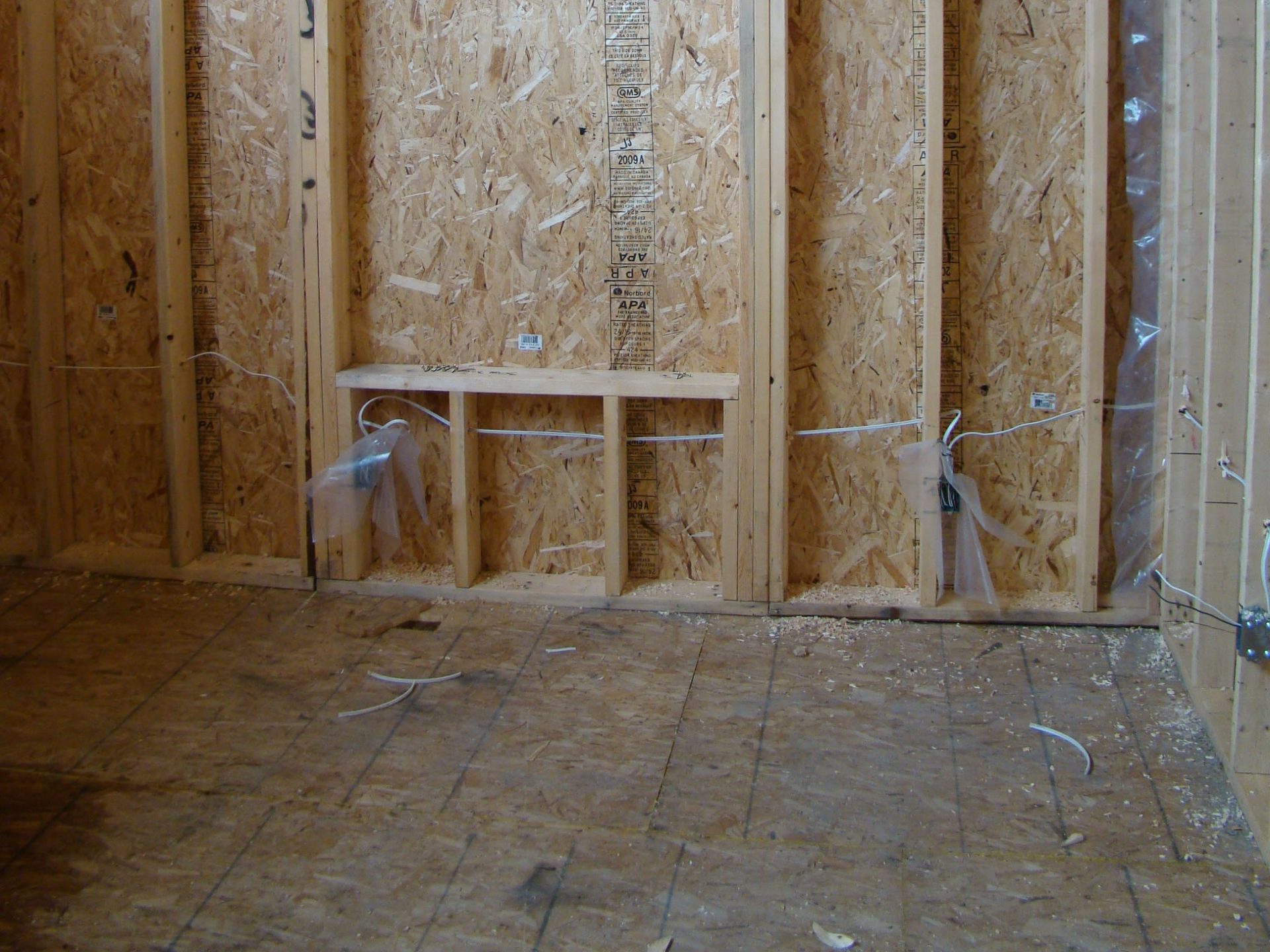
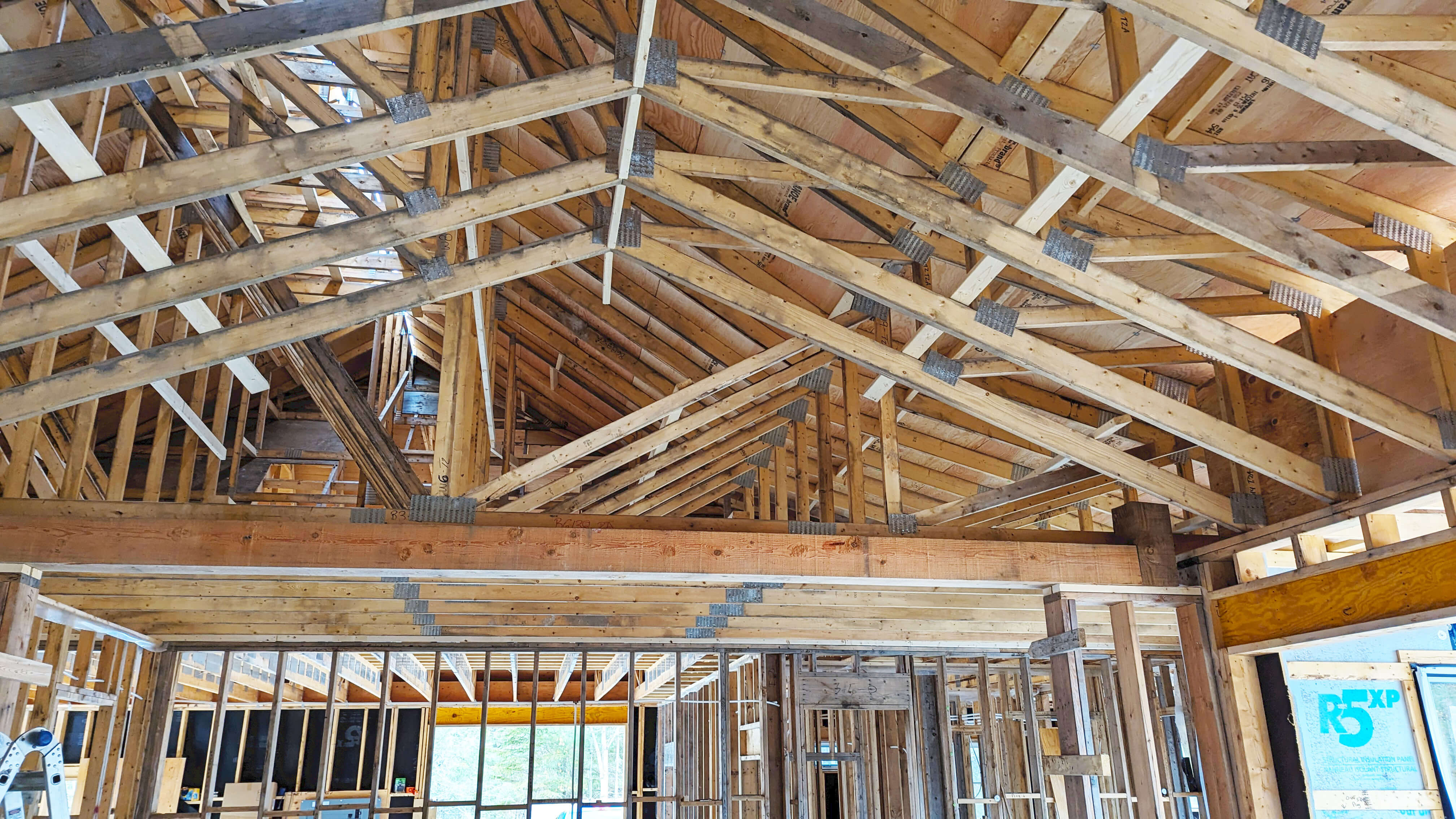
Traditional Missouri framing needs 4-8 weeks subject to weather and crew access. Prefab framing condenses structural operations to 1-3 weeks independent of conditions—critical when 19.9% sell above listing and supply reaches just 2 months.
Missouri Success: A 3,000 sq ft home in Jackson County achieved complete structural assembly in two and a half weeks—traditional approaches would need 7+ weeks. Interior operations began six weeks early in a market where homes close in 47 days and 55.4% inbound migration sustains demand.
Missouri construction confronts persistent workforce challenges despite competitive regional costs. Experienced framers remain scarce. Prefab framing cuts skilled needs 60% while preserving quality benchmarks.
Owner-Builder Achievement: Missouri’s affordability magnetizes first-time owner-builders. Prefab framing converts complex structural operations into manageable installation using comprehensive guidance and precision elements.
Factory-managed production virtually eliminates Missouri construction variables. Humidity doesn’t compromise materials. Temperature and moisture variations don’t impact dimensions. Crew rotation doesn’t generate quality fluctuations.
Trade Performance: Dimensional reliability enables drywall, flooring, and trim professionals to operate efficiently without continuous adaptation to framing problems—delivering finishes Missouri purchasers anticipate.
Missouri construction operates 4% under national benchmarks at $100-$180 per square foot. Prefab framing secures material expenses during production, shielding budgets from variations while cutting waste—maintaining Missouri’s competitive stance.

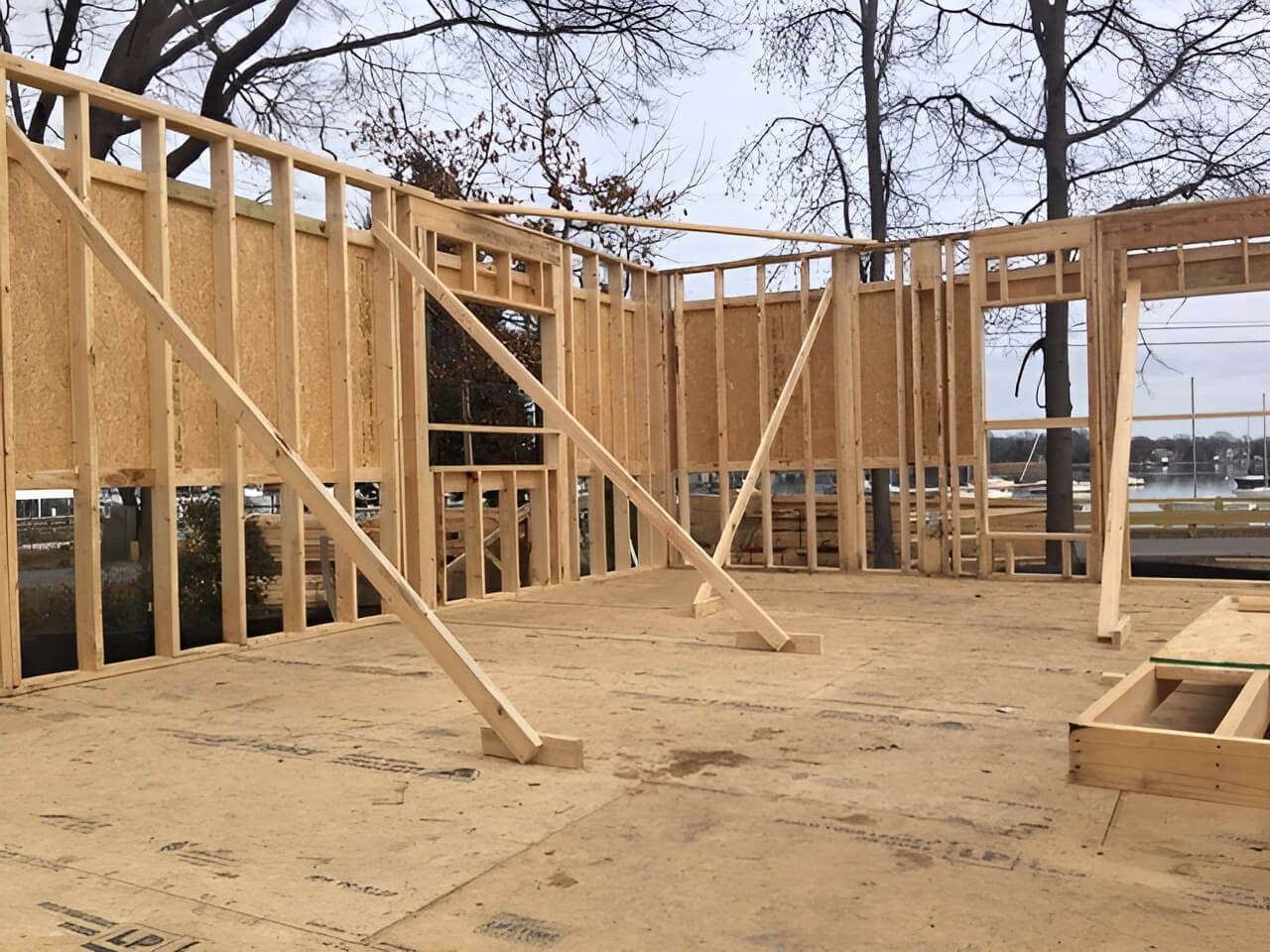
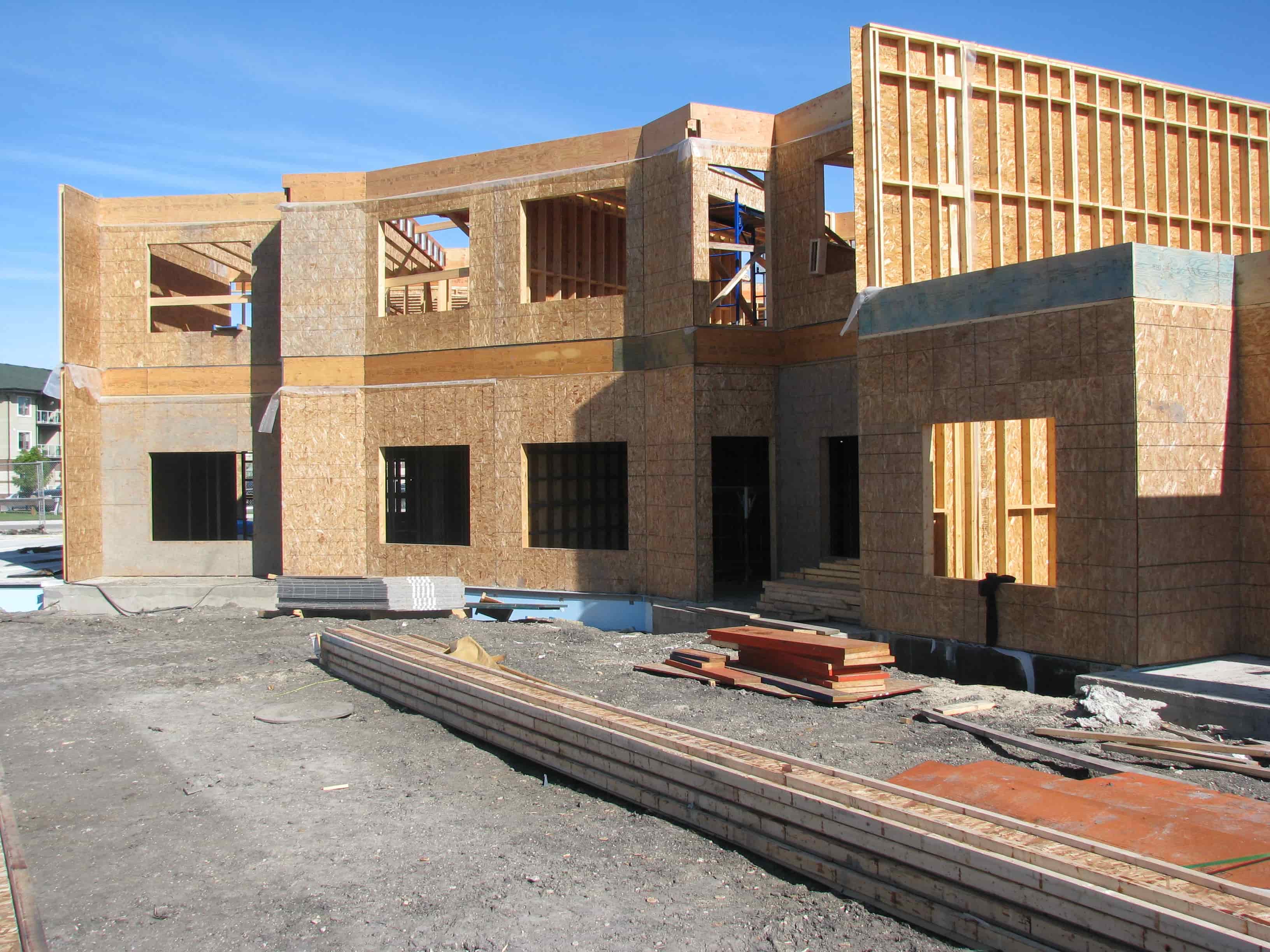
Missouri’s competitive costs attract numerous first-time owner-builders ready to tackle their dream homes. Prefab framing converts intimidating projects into achievable construction:
Professional builders integrate prefab framing seamlessly with distinctive designs while protecting compressed margins:
Multi-unit projects profit from advantages that directly impact the bottom line:
Phase 1: Project Evaluation
Submit your architectural plans or select from available standard models. The Green-R-Panel team reviews your project objectives, answers questions, and provides clear, accurate pricing tailored to Missouri construction requirements.
Phase 2: Design & Engineering
All structural components are developed using advanced AutoCAD-based drafting. Systems are manufactured to your exact specifications and in compliance with Missouri building codes. You review and approve all layouts prior to production.
Phase 3: Precision Manufacturing
Wall panels, engineered floor systems, and roof trusses are produced in climate-controlled facilities. Comprehensive quality control ensures every component meets strict tolerances and performance standards.
Phase 4: Coordinated Delivery
Components are organized and packaged for efficient installation. Delivery is scheduled around site readiness and local construction timelines. Each shipment includes complete installation documentation to support smooth on-site assembly.
Phase 5: Ongoing Support
Every project includes sealed roof truss drawings for permitting, with continued technical and customer support available throughout the construction process.
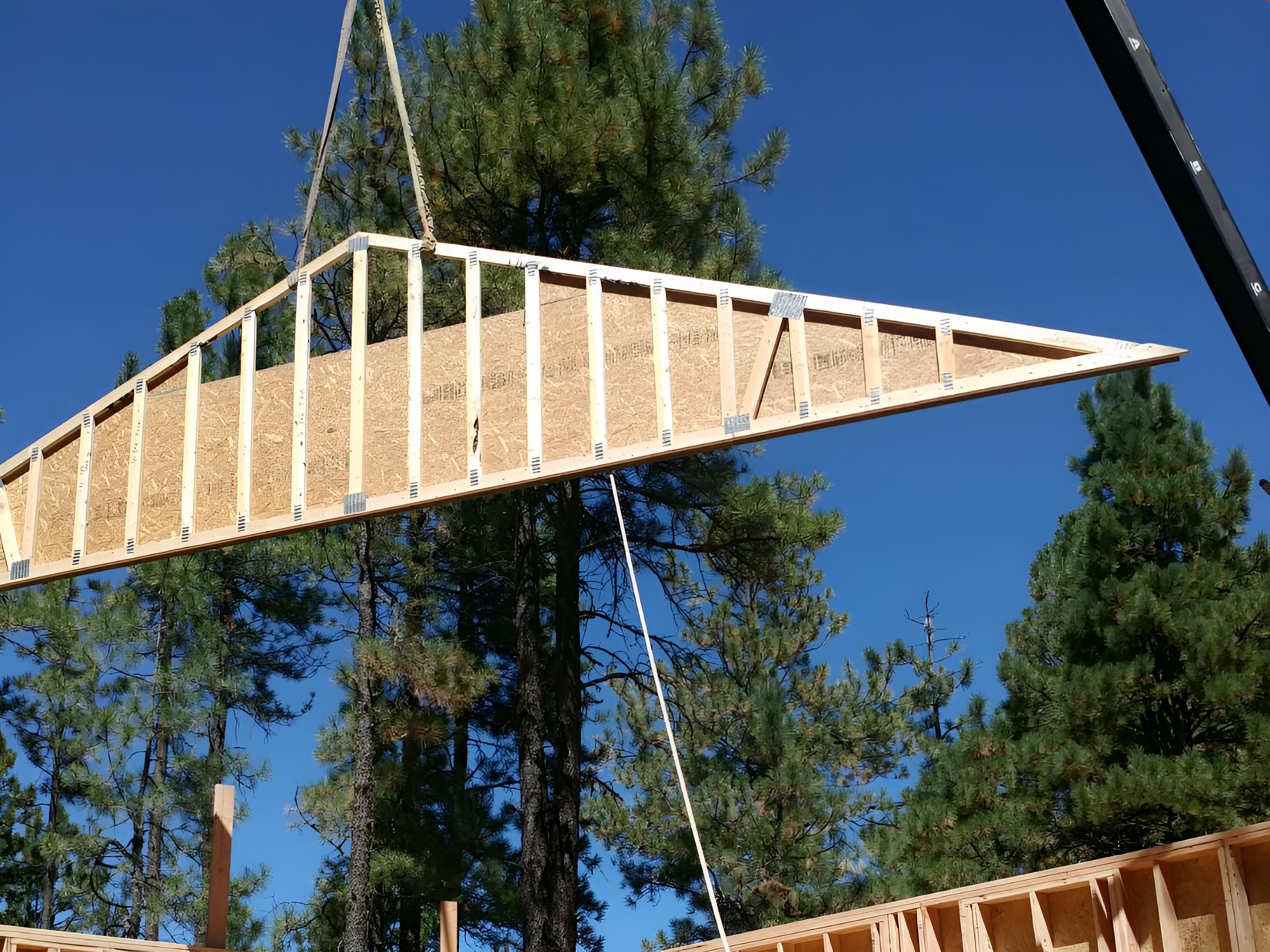
Missouri builders report consistent prefab framing benefits:
Workforce Savings: 60% skilled framing decrease typically preserves $14,000-$26,000 on 2,500 sq ft homes
Material Conservation: 15-20% waste reduction preserves $4,000-$9,000 through controlled production
Schedule Benefits: 4-6 week acceleration preserves carrying expenses, enables quicker completion—vital for Missouri’s migration-driven market
Quality Outcomes: Decreased callbacks and warranty issues enhance sustained profitability
Prefab framing optimizes results for Missouri construction:

Missouri’s market rewards builders responding efficiently to sustained demand while maintaining affordability.
Home prices rose 7.0% year-over-year in November 2025, reaching a median of $280,500. Inventory increased to 27,310 homes available—up 8.2% year-over-year. Homes now sell in 40 days on average, giving buyers slightly more time than last year’s frenzied pace.
Opportunities flourish for efficient builders delivering quality rapidly in a market where 3 months of supply still signals seller-friendly conditions.
Traditional approaches face mounting schedule and workforce obstacles. Builders commanding efficient methodologies while leveraging Missouri’s 4% cost advantage below national benchmarks will dominate markets where others struggle.
Whether planning Kansas City custom construction, Columbia developments, or Springfield projects, prefab framing delivers proven solutions for Missouri’s migration-powered building environment.
Missouri prefab homes don’t require sacrificing quality for affordability.
Prefab framing systems deliver factory precision matching your specifications while preserving complete design freedom and Missouri’s competitive cost positioning.
Contact Green-R-Panel today for Missouri project discussions. From opening consultation through delivery, we provide expertise and support for successful construction in Missouri’s migration-driven marketplace.
Begin your Missouri-focused consultation discovering how prefab framing systems enhance your building venture.